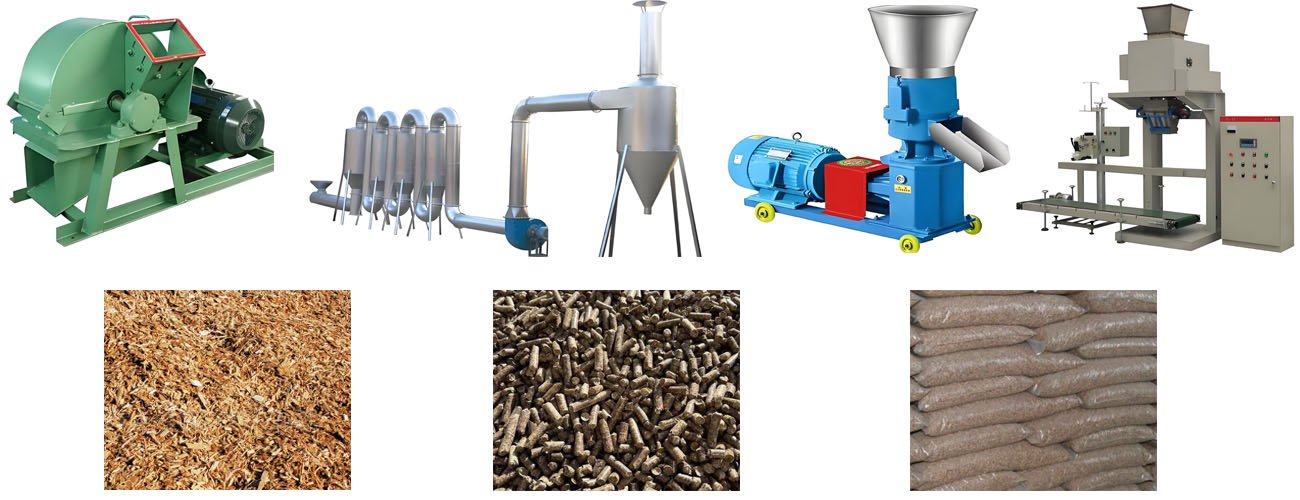
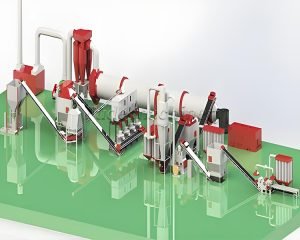
If you want to turn wood waste into valuable biomass fuel, you need the right equipment for producing wood pellets. This is not about a single machine, but a complete system working together. At FUDE Machinery, we provide the entire setup. The process generally includes five key steps: crushing, drying, pelletizing, cooling, and packing. Each step requires a specific machine to prepare the material for the next stage, ensuring you produce high-quality, dense wood pellets for your customers.
What are the key machines in a wood pellet production line?
A complete wood pellet production line has five main types of machines. Each one performs a critical task. You have the wood crusher for size reduction. Next is the rotary dryer to control moisture. The heart of the line is the wood pellet machine. After that, a pellet cooler hardens the pellets. Finally, a pellet packing machine prepares them for sale.
Think of it like an assembly line. If one machine is wrong or missing, the whole process fails. For example, if you feed wet sawdust into the pellet mill, you will get soft, useless pellets. That is why we, as an experienced manufacturer, always look at your entire operation. We help you select the right equipment for producing wood pellets that work together perfectly, from the raw material you have to the final product you want to sell.
Using a wood chipper, raw materials such as logs, wood chips, and branches are shredded into fine particles measuring 3-10mm, providing uniform feedstock for subsequent pelletization.This is extremely important. If the pieces are too big, they can’t be pressed properly in the pellet mill. It can also damage the expensive die and rollers inside the wood pellet machine.
After crushing, the next critical step is drying. The ideal moisture content for pelletizing is between 12% and 15%. Most raw materials, like fresh sawdust or crop residues, contain 40-50% moisture or even more. If the material is too wet, the steam created during pelletizing will cause the pellets to crack or expand. If it’s too dry, it won’t bind together properly. You need a rotary dryer to get the moisture just right.
Our industrial rotary dryers use a flow of hot air to reduce the moisture content of your crushed material precisely. The material tumbles through a large rotating drum while hot air passes over it. The speed and temperature are controllable. This gives you consistent results every time. Investing in a good dryer is not optional; it is essential equipment for producing wood pellets. It is the key to producing strong, durable pellets that won’t crumble during transport and will burn efficiently for the end-user.
This is the central piece of your entire operation. The wood pellet machine, also known as a pellet mill, is where the prepared sawdust is transformed into pellets. The machine uses a combination of intense pressure and heat. The raw material is fed into a chamber with a die, which is a thick steel plate with many small holes drilled through it. One or more rollers then press the material through these holes.
The extreme pressure generates heat, which causes the lignin, a natural polymer in the wood, to become a liquid binder. As the material is forced through the die, it forms dense, compressed pellets. A cutter on the outside of the die then slices the pellets to a uniform length. We manufacture both flat die and ring die pellet mills. Ring die mills are generally used for larger-scale industrial production because they are more durable and efficient for continuous operation. This machine truly is the heart of any biomass pellet mill setup.
Pellet Cooling Equipment
When the pellets come out of the wood pellet machine, they are very hot (around 70-90°C) and quite soft. You cannot package or store them immediately. If you do, the trapped heat and moisture will cause them to break down. You need a pellet cooler to bring their temperature down to just above room temperature and to harden them.
We typically use a counter-flow cooler. Hot pellets are fed into a cooling chamber from the top. Cool air is drawn up from the bottom, passing over the pellets. This process gently removes the remaining heat and moisture. It allows the lignin to solidify completely, making the pellets hard and durable. This cooling step is crucial for maintaining the quality and shelf life of your final product. Properly cooled pellets are less likely to produce dust and will stand up to the rigors of bagging, storage, and transportation.
Pellet Packing Equipment
The final step is packaging. A reliable pellet packing machine makes your product ready for the market. This equipment can weigh the pellets automatically and fill them into bags of a specified weight, for example, 15kg or 25kg. After filling, the machine seals the bags to protect the pellets from moisture and contamination. For large industrial clients, you might also have an option for filling one-ton bulk bags.
Automating this process with the right equipment for producing wood pellets is very important for commercial operations. It saves you a lot of labor costs. It also ensures that every bag your customer buys has the correct weight. Professional, well-sealed bags also improve your brand image and make your product more attractive to distributors and end-users. It is the final touch that prepares your high-quality pellets for sale.
How do you select the right equipment?
Selecting the right equipment starts with understanding your raw material and your business goals. First, analyze your feedstock. Is it hardwood or softwood? What is its typical size and moisture content? This will determine the type of crusher and the capacity of the dryer you need. Hardwoods, for example, require a more robust wood pellet machine with a stronger motor.
Second, define your production target. How many tons of pellets do you want to produce per day? This will determine the size and capacity of every machine in the line. It is always a good idea to plan for future growth. We often advise clients to choose a line with about 20% more capacity than their immediate needs. As a factory-direct manufacturer, we can help you with this calculation.
Key Factors for Your Decision
Here is a simple table to guide you. Use it to think about your specific needs before you contact a supplier.
Factor
Key Questions for You
Why It’s Crucial for a B2B Buyer
Raw Material
What type of wood/biomass do you have? Size? Moisture?
This determines the required machine power, durability, and pre-processing steps. Using the wrong machine will lead to breakdowns.
Capacity (Tons/Hour)
What is your target output?
This dictates the size and cost of the entire line. Mismatching machine capacities creates bottlenecks and inefficiency.
Automation Level
Do you want a fully automatic or semi-automatic line?
Higher automation reduces labor costs but requires a larger initial investment. We can design both.
Budget
What is your total project budget?
As a manufacturer, we offer competitive pricing. Knowing your budget helps us recommend the most cost-effective solution without sacrificing quality.
Types of pellet machines
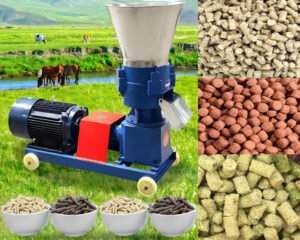
A pellet machine is a device that compresses powdered or small pieces of material (such as sawdust, straw, feed, etc.) into pellets through mechanical pressure.
Principle: The material is extruded from the mold hole through the compression of the pressure wheel and the flat mold.
Pressure adjustable: The clearance between the pressure wheels can be adjusted to adapt to different materials (such as coarse fiber straw).
Simple structure: easy to maintain, suitable for small-scale production.
Application scenarios: Home workshops, small and medium-sized feed mills, agricultural biomass energy projects.
Product advantages of wood pellet machine
Efficient production: Automated linkage control achieves 24-hour stable operation, with a daily output of tens of tons, suitable for medium and large particle processing plants.
Intelligent management: PLC+touch control system monitors real-time temperature, production, power consumption and other data, supports remote debugging and warning linkage, and is easy to operate.
High quality finished particles: The particles are tightly and evenly formed, with a calorific value of ≥ 4200kcal/kg, ash content ≤ 1.5%, moisture content ≤ 10%, density ≥ 1.1g/cm ³, and no need to add adhesives.
Wide applicability of raw materials: It can process various types of wood waste such as pine, poplar, oak, bamboo chips, furniture scraps, and board scraps. When the moisture content is ≤ 20%, it can be efficiently formed by drying.
The practical application of sawdust particles
Biomass energy substitution: Using wood chips as clean fuel to replace traditional energy sources such as coal and fuel for power generation, heating, and civilian heating.
Stable calorific value: Particle calorific value ≥ 4200kcal/kg, high combustion efficiency.
Reuse of wood processing waste: Processing sawdust, shavings, scraps and other waste from furniture factories, board factories, and artificial board enterprises to achieve the goal of “turning waste into treasure”
Frequently Asked Questions
Question 1:What is the most important piece of equipment for producing wood pellets?
The wood pellet machine, or pellet mill, is the core of the operation. It’s where the raw material is compressed into dense pellets. However, its performance depends heavily on the preparation steps, making the crusher and dryer equally critical for a high-quality final product.
Question 2: What raw materials can be used to make wood pellets? You can use a wide range of biomass. This includes sawdust, wood shavings, tree branches, logging residues, and agricultural waste like straw, corn stalks, and rice husks. Our equipment can be customized to handle your specific raw material.
Question 3: Do I need a dryer for my wood pellet production line? You need a dryer if your raw material’s moisture content is above 15%. Most fresh wood or agricultural waste is much wetter than this. Proper drying is essential to create strong, dense pellets that burn efficiently.
Question 4: What is the difference between a flat die and ring die pellet mill? A flat die pellet mill is generally smaller and suitable for small-scale production or for processing softer, lighter materials. A ring die pellet mill is built for heavy-duty, continuous industrial production. It offers higher efficiency and longer part life, making it the standard choice for most commercial biomass pellet mill operations.
Conclusion
Building a successful business in the biomass industry requires the right equipment for producing wood pellets. It is a complete system where every machine, from the wood crusher to the packing machine, plays a vital role. Understanding this process is the first step toward making a smart investment. The quality of your machinery directly impacts the quality of your pellets and the profitability of your business.
We encourage you to think of this as a long-term partnership. By choosing a manufacturer like FUDE Machinery, you get more than just machines. You get a complete, customized solution designed for your specific needs, backed by full-service support. Our factory-direct model ensures you receive high-quality equipment at a competitive price, giving your business a strong foundation for growth.
Contact us today to discuss your project. Let us provide a professional, customized solution for you.
A feed pellet machine is a specialized equipment for compressing feed raw materials into pellets. Its core function is to convert crushed raw materials such as corn, soybean meal, straw, forage, rice husk, etc. into granular feed through physic...
Do you want your chickens to grow well? Are you looking at feed bags? Good chicken pellet feed has specific parts. Good chicken pellet feed has essential nutrients for birds. These include protein, carbohydrates, fats, vitamins, and minerals. C...
 Fude Machinery-wood crusher manufacturer



HelloPlease log in