A wood chipper machine cuts logs, branches, bamboo, and other woody materials into uniform wood chips. At FUDE Machinery, we configure wood chippers according to your raw material, required capacity, feeding size, power supply, and target chip size. Our machines can support wood processing plants, paper mills, biomass facilities, sawmills, and wood recycling projects.
Unlike a wood crusher that produces fine sawdust, a wood chipper uses sharp knives to slice material into larger and more uniform chips. This difference matters when your final product will be used for pulp, particleboard, biomass fuel, landscaping, or further pellet production.
A wood chipper machine is industrial equipment that cuts wood into chips with controlled dimensions. The main cutting parts are mounted on a rotating disc or drum. Feeding rollers move the material toward the knives. The knives then slice the wood instead of crushing it through repeated impact.
This cutting method produces chips with cleaner edges and more consistent dimensions than a hammer mill or sawdust crusher. The finished chips can be used as pulp material, particleboard feedstock, biomass boiler fuel, landscaping mulch, or raw material for further processing.
A commercial wood chipper normally includes a machine frame, feeding inlet, cutting unit, knives, power system, safety cover, and discharge system. Larger machines may also use hydraulic feeding rollers and conveyors. These systems keep the feeding speed stable and help the machine process material continuously.
The correct machine depends on the wood diameter, wood type, moisture level, required chip quality, and hourly production target. A small workshop and a large paper mill should not use the same chipper configuration.
Wood Chipper Models and Specifications
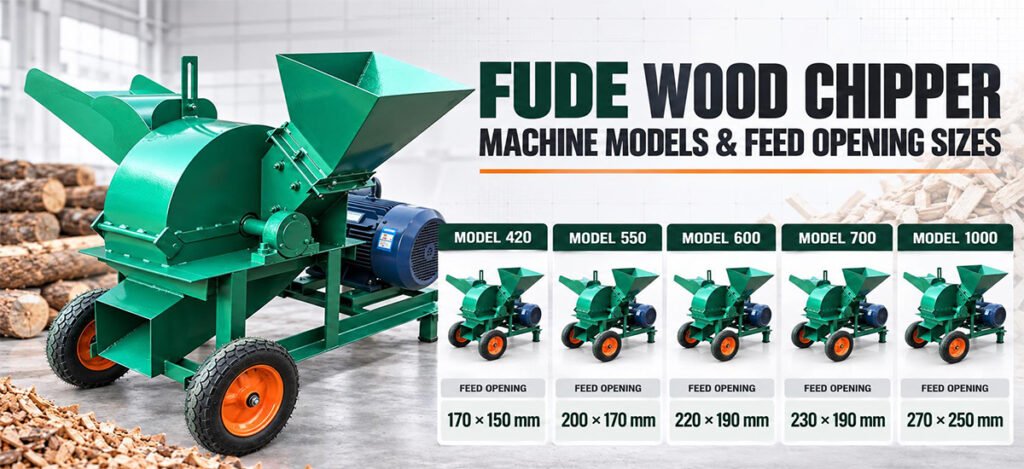
FUDE wood chippers are available in several sizes. The following configurations provide a general reference for model selection.
Model
Capacity
Motor Power
Spindle Speed
Number of Blades
Feed Opening
Machine Weight
400
About 1 t/h
7.5–11 kW
650 r/min
3
150 × 150 mm
160 kg
600
About 2 t/h
15 kW
600 r/min
3
180 × 150 mm
380 kg
800
About 5 t/h
30 kW
550 r/min
4
200 × 200 mm
520 kg
1000
About 8 t/h
37 + 1.5 kW
550 r/min
4–6
230 × 250 mm
950 kg
1200
About 12 t/h
75 + 1.5 kW
500 r/min
4–6
330 × 300 mm
2,000 kg
Actual capacity can change with wood species, moisture, log diameter, feeding method, blade condition, and target chip size. Wet hardwood and irregular branches usually require more power than straight softwood logs.
Before we recommend a model, we ask you to provide the following information:
Raw material type
Maximum feeding diameter
Average feeding diameter
Material moisture
Required chip length and thickness
Required hourly capacity
Available voltage and frequency
Fixed or mobile operating requirement
We use this information to match the feed opening, motor power, knife configuration, and discharge system to your project.
How Does a Wood Chipper Work?
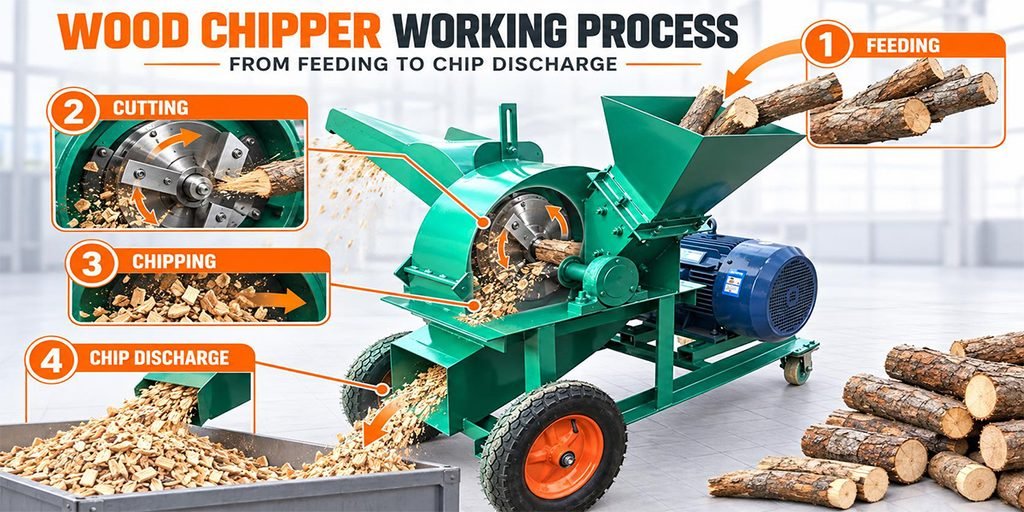
A wood chipper completes four main steps: feeding, gripping, cutting, and discharging.
First, the operator or feeding conveyor places the wood into the inlet. The inlet must be large enough for the maximum log or branch diameter. Oversized or highly irregular material should be cut or sorted before feeding.
Second, the feeding system grips the material and moves it toward the cutting unit. Small disc chippers may use simple gravity feeding. Larger machines normally use powered or hydraulic feed rollers. Controlled feeding reduces sudden loading and helps the machine produce consistent chips.
Third, the rotating knives slice the wood. Knife sharpness, knife angle, knife projection, feed speed, and the clearance between cutting parts all affect chip quality. Worn knives can increase fines, power use, vibration, and irregular chip size.
Finally, the discharge system moves the finished chips out of the cutting chamber. Depending on the design, the machine may use airflow, a bottom outlet, or a discharge conveyor. The chips can then enter a collection area, screening system, storage bin, dryer, or the next processing stage.
A wood chipper should not be confused with a sawdust machine. A chipper produces larger chips, while a sawdust machine reduces material into smaller particles.
What Materials Can It Process?
A correctly configured wood chipper can process many clean woody and fibrous materials.
Common materials include:
Straight logs
Small-diameter timber
Tree branches
Sawmill offcuts
Wood slabs
Bamboo
Veneer waste
Logging residue
Clean wood boards
Selected agricultural stalks
Material condition is important. Clean wood is easier on the knives and usually produces better chips. Wood that contains nails, screws, stones, or other hard contaminants can damage the cutting system.
If you need to process used pallets, construction formwork, demolition timber, or wood containing nails, an industrial wood crusher may be more suitable. That type of machine is designed for rougher and more contaminated material.
You should also tell us whether the material is straight, curved, bundled, loose, wet, or dry. A machine that works well with straight logs may not feed loose branches efficiently without powered rollers or a wider inlet.
What Output Does a Wood Chipper Produce?
The main output is process wood chips. Chip dimensions depend on the machine type, knife setup, feed speed, wood condition, and adjustment method.
Typical applications may require different chip specifications:
Application
Required Output
Main Concern
Pulp and paper
Uniform, clean chips
Consistent length and thickness
Particleboard
Controlled wood chips
Low oversize content
Biomass boilers
Fuel-grade chips
Stable feeding and moisture
Pellet production
Chips for further grinding
Easy transfer to a hammer mill
Landscaping
Decorative or functional mulch
Appearance and size consistency
Wood recycling
Reusable chip material
Contamination control
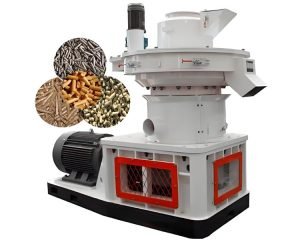
For pellet production, the wood chipper is usually the first size-reduction stage. The chips then enter a hammer mill or sawdust machine before drying and pelletizing. You can review the next processing stage on our biomass pellet mill page.
A screen or downstream screening system can separate oversized pieces when a project requires tighter output control. However, the exact chip size should be confirmed through a material test because different wood species behave differently during cutting.
Disc Chipper vs Drum Chipper
Disc and drum chippers both produce wood chips, but they serve different operating conditions.
Disc Wood Chipper
A disc wood chipper uses a large rotating disc with knives installed on its surface. The wood enters at an angle, and the knives slice it as the disc rotates.
Disc chippers are often selected when chip uniformity is important. They work well with straight logs, wood slabs, bamboo, and clean sawmill material. Their compact structure can also suit smaller processing sites.
A disc chipper may be the better choice when:
Your raw material is relatively straight and clean.
A drum wood chipper uses a rotating cylindrical knife roller. The feeding system pushes material toward knives installed around the drum.
Drum chippers are commonly used for continuous industrial production. They can accept larger feed openings and work with logs, branches, slabs, and other bulky materials. Hydraulic feeding systems help manage uneven material.
A drum chipper may be the better choice when:
You process large volumes of wood.
Your material includes irregular logs or branches.
You require continuous industrial feeding.
Your production line uses conveyors.
Capacity is more important than a compact footprint.
Neither design is automatically better. The correct choice depends on your raw material and finished product.
Electric vs Diesel Wood Chippers
Electric motors are normally suitable for fixed factories. They provide stable power, simpler daily operation, and lower routine maintenance. They also avoid exhaust emissions at the working point.
A diesel engine is useful when the machine must operate in a forest, farm, orchard, or temporary processing site without a stable electrical supply. Diesel power gives you more location flexibility, but fuel cost and engine maintenance are normally higher.
When selecting a power system, check:
Local voltage
Electrical frequency
Three-phase power availability
Maximum available transformer capacity
Fuel availability
Daily operating hours
Local emission requirements
Need for mobile operation
Do not select the motor only by its listed power. Dense hardwood, wet material, large feeding diameter, and high capacity can increase the real operating load.
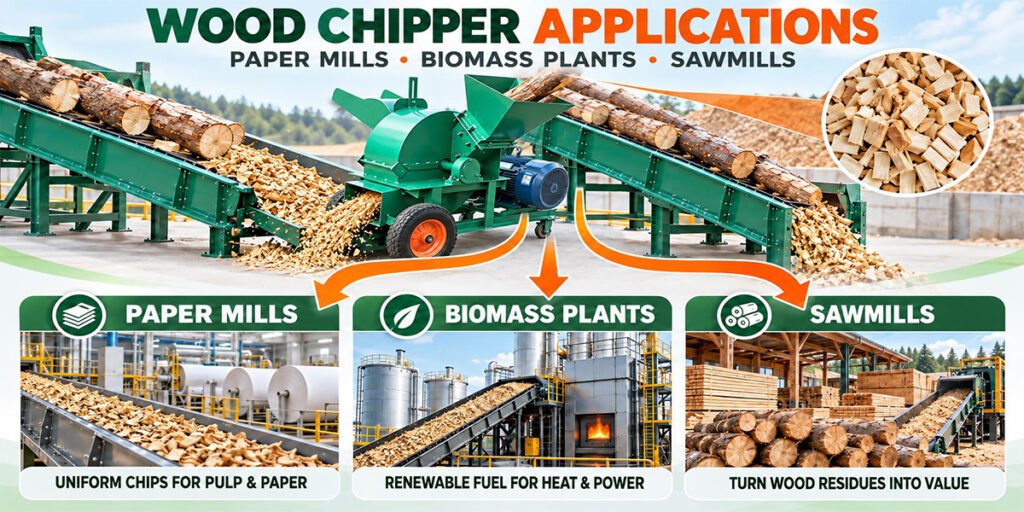
Wood Chipper Applications
Pulp and Paper Production
Paper mills need wood chips with controlled dimensions. Uniform chips support stable chemical penetration and more consistent pulping. A disc chipper is often suitable when clean chip quality is the main priority.
Particleboard and Fiberboard
Panel factories use wood chips and smaller wood particles as raw material. A chipper can serve as the first processing stage before further size reduction, drying, screening, and board production.
Biomass Fuel
Wood chips can be used in suitable industrial boilers or processed further into biomass pellets. Drum chippers are often selected for higher-volume biomass projects because they can handle a broader range of forestry material.
Sawmill Waste Recycling
Sawmills can convert slabs, offcuts, and selected waste wood into usable chips. This reduces waste volume and creates material for pulp, panels, boilers, or pellet plants.
Farms and Landscaping
Branches from orchards, farms, parks, and landscaping work can be converted into mulch or biomass material. A small or mobile chipper may be more practical when the machine must move between sites.
How to Choose the Right Wood Chipper
You should begin with the raw material, not the machine model.
1. Confirm Your Maximum Feed Size
Measure the largest diameter and width that the machine will receive. Do not use only the average size. A feed opening that is too small will slow production and require extra cutting work.
2. Define Your Required Capacity
Estimate how many tons you need to process each hour and each day. Include peak periods. Running a small machine continuously at maximum load can increase wear and downtime.
3. Confirm the Final Chip Specification
Different buyers require different chip dimensions. Ask your paper mill, panel plant, boiler supplier, or downstream process for its acceptable range before ordering the chipper.
4. Identify Contamination
Clean wood and contaminated waste wood need different equipment. A knife-based wood chipper should not be the first choice for material containing metal, stones, or demolition debris.
5. Choose the Power Source
Use an electric motor for stable factory operation. Consider diesel power when mobility or remote operation is necessary.
6. Plan Feeding and Discharge
Manual feeding may be acceptable for a small machine. A larger line may require loading equipment, feed conveyors, hydraulic rollers, discharge conveyors, screening, and storage bins.
7. Consider Maintenance Access
Check how operators open the housing, replace knives, adjust clearances, lubricate bearings, and remove blocked material. Good maintenance access reduces downtime.
Maintenance and Wear Parts
Regular maintenance protects chip quality and production capacity.
Recommended routine checks include:
Inspect knives for wear, cracks, and loose fasteners.
Check the bed knife or counter knife clearance.
Lubricate bearings according to the maintenance schedule.
Inspect belts, couplings, and transmission parts.
Remove accumulated wood dust and chips.
Check feeding rollers and hydraulic parts.
Test emergency stops and safety guards.
Monitor vibration, noise, and bearing temperature.
Keep metal and stones out of the feed material.
Knife service intervals depend on wood species, contamination, operating hours, and required chip quality. Hardwood and dirty material can shorten knife life. Operators should inspect the knives regularly instead of waiting for a major drop in capacity.
Before purchasing, ask for a wear-parts list. It should identify the knives, bolts, bearings, belts, screens, and other parts that may require periodic replacement.
Installation and Site Requirements
The site must have enough space for safe feeding, operation, maintenance, and material discharge. Large chippers also require a stable foundation and suitable lifting equipment for installation and knife maintenance.
Your installation plan should consider:
Machine dimensions
Foundation requirements
Loading direction
Conveyor length
Discharge height
Electrical cabinet location
Dust control
Noise management
Operator access
Maintenance clearance
Finished-chip storage
Fire prevention
For a complete production line, the capacity of each machine must match. A high-capacity chipper will not improve the line if the downstream grinder, dryer, or conveyor is too small.
Wood Chipper Price Factors
The price of a wood chipper depends on more than the model number.
Important price factors include:
Feed opening
Production capacity
Motor or diesel engine
Disc or drum cutting system
Number and material of knives
Hydraulic feeding system
Feed and discharge conveyors
Electrical control system
Mobile frame or fixed installation
Voltage customization
Spare-parts package
Packaging and shipping destination
For an accurate quotation, send us your raw material photos or videos together with the required feed size, chip size, and capacity. We can then recommend a suitable configuration instead of quoting a machine that may not match your process.
Wood Chipper Machine FAQ
Can a wood chipper produce sawdust?
A wood chipper mainly produces wood chips. If you need fine sawdust, the chips normally require a second grinding stage using a hammer mill or sawdust machine.
Can it process wet wood?
A wood chipper can process wood with natural moisture, but very wet material may affect feeding, chip quality, capacity, and downstream storage. Send us the approximate moisture level before model selection.
Can it process pallets with nails?
A knife-based wood chipper is not recommended for wood containing nails. Metal can damage the knives and cutting system. Use equipment designed for contaminated waste wood.
What chip size can the machine produce?
Chip size depends on the machine type, knife setup, feed speed, and raw material. The exact target should be confirmed before production and checked through a material test when necessary.
Should I choose a disc or drum chipper?
Choose a disc chipper for clean wood and more uniform chips. Choose a drum chipper for higher capacity, larger feed openings, and more varied woody material.
Can the machine use a diesel engine?
Selected models can be configured with a diesel engine. Diesel power is useful for farms, forests, and work sites without reliable three-phase electricity.
Can FUDE customize the machine voltage?
We can configure the electrical system according to the voltage and frequency information you provide. Always confirm the destination-country power standard before production.
What information is required for a quotation?
Please provide the raw material, maximum feeding size, moisture, required chip size, hourly capacity, power supply, operating location, and delivery country.
Request a Wood Chipper Quote
We configure wood chipper machines according to real processing requirements. To receive a model recommendation and quotation, send us:
Photos or videos of your raw material
Maximum log or branch diameter
Required wood chip size
Required hourly capacity
Available voltage and frequency
Fixed or mobile operating requirement
Destination country or port
FUDE Machinery can help you compare disc and drum chippers, select a suitable power system, and plan the required feeding and discharge equipment.
Contact us with your project information to receive a wood chipper configuration and factory quotation.
drum chipper drum wood chipper machine is a specialized equipment for making wood chips, widely used in the production of wood chips in papermaking, particleboard, high-density fiberboard factories. It can cut high-quality industrial wood chi...
The pellet making machine mainly produces wood chips, straw, rice husks, bark, etc., which are processed and solidified into high-density pellet fuels. A complete pellet plant is not just a pellet mill; it is a fully integrated production line whe...
The wood peeling machine is mainly composed of feeding mechanism, discharging mechanism, cutting disc, transmission system, chassis, and other parts, and belongs to one of the wood processing machinery series products; The wood peeling machine, as...
Comprehensive Crusher uses a two-stage process of high-impact blades and heavy-duty hammers to break down complex, mixed wood waste. This hybrid system is what makes it so unique and effective. Unlike a simple chipper or shredder, it is engineered...
Hi I am in Australia and interested in your 420 machine with petrol engine. Can you advise cost DDP to Medowie NSW Australia 2318 and do you have a video of machine doing heavy work
 Fude Machinery-wood crusher manufacturer



Hi I am in Australia and interested in your 420 machine with petrol engine. Can you advise cost DDP to Medowie NSW Australia 2318 and do you have a video of machine doing heavy work
2026-09-1117:22
Hello, what is your WhatsApp number? That would make it easier for us to send you a video showing how to operate the device.
2026-09-2010:26